


Billiards: A Battle of Precision and Power
Billiards: A Battle of Precision and Power
Russian billiards, or Russian Pyramid (sometimes simply called “Pyramid”), is not just a regional variation of the game; it is a distinct discipline with its own unique rules, physics, and philosophy. Unlike the fast-paced nature of American Pool, Pyramid is a game of patience, strategic thinking, and surgical precision that demands absolute mastery of cue control.
1. Key Difference: Pocket and Ball Size
The main feature that shocks newcomers to Russian Billiards is the unforgiving ratio of ball size to pocket size – a challenge that separates casual players from true masters.
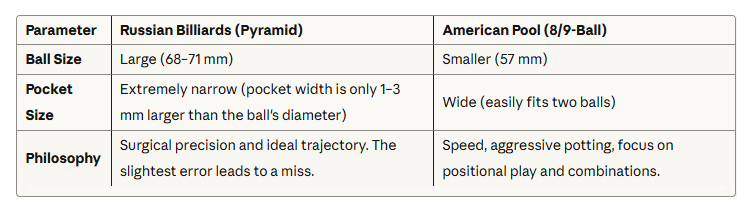
Interesting Fact: Due to the incredibly narrow pockets in Russian Pyramid, even a shot where the ball merely “kisses” the edge of the pocket without falling in is considered a missed shot. Professional players often spend years perfecting the exact angle and speed needed for successful pots.
2. Ball Specifics
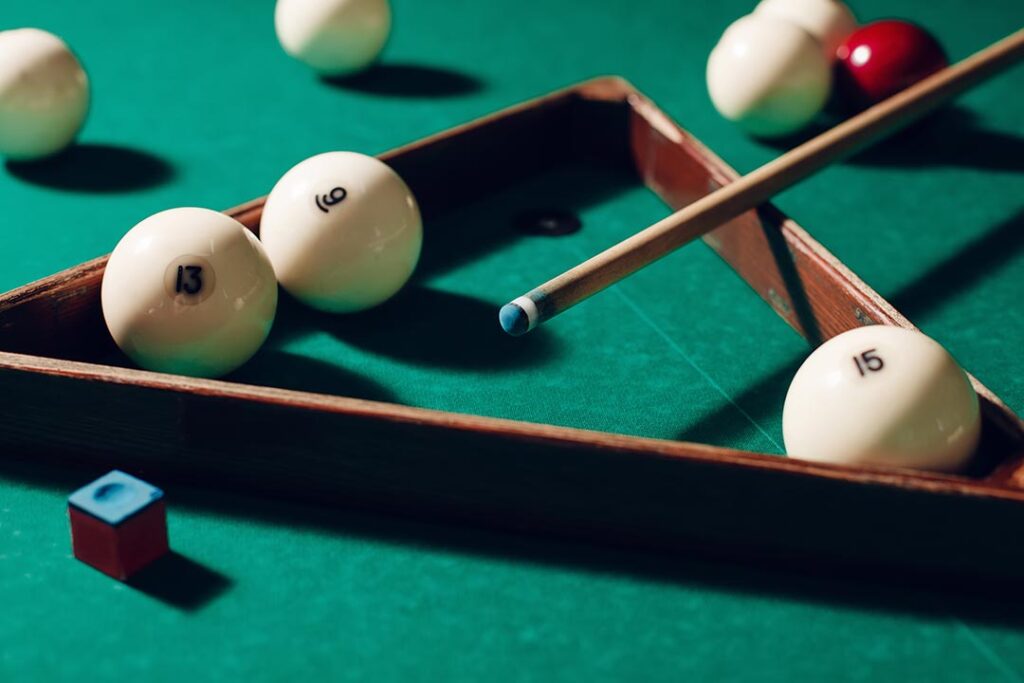
Russian Pyramid uses 16 balls, similar to Pool, but with crucial differences:
- 15 white (or ivory-colored) balls, which may be numbered or unnumbered depending on the variation being played.
- One colored ball (usually red or yellow) – traditionally used as the cue ball (the ball that is struck first).
This contrasts sharply with American Pool, where balls have distinctive colors and patterns (solids and stripes), making target identification immediate and intuitive.
3. The Core Rules (Game Mechanics)
Russian Pyramid features unique rules that fundamentally change the nature of play:
- Any ball can be a cue ball: Unlike Pool, where only the white cue ball can be struck, in Pyramid the player can use any ball on the table to strike another ball. This adds layers of tactical complexity.
- The “Own-Foreign” Rule (Свой-Чужой): Players can pot either:
- A “foreign” ball (any ball other than their chosen cue ball), or
- Their “own” ball (the cue ball itself), but only if it contacts at least one other ball before falling into the pocket.
- Combination Play: The ability to use any ball as a striker means that advanced players can execute complex multi-ball combinations that would be impossible in standard Pool.
4. Table Dimensions
Russian Pyramid tables are significantly larger than Pool tables:
- Standard size: 12 feet (3.6 meters) in length
- Comparison: American Pool tables typically range from 7 to 9 feet
The larger playing surface, combined with the challenging pocket dimensions, makes long-distance shots exponentially more difficult.
5. Fascinating Facts
- Tsarist Origin: Billiards was introduced to Russia by Peter the Great in the early 18th century from the Netherlands. However, over centuries the game evolved dramatically, adapting to Russian craftsmanship and cultural preferences, ultimately transforming into the unique discipline known as Pyramid.
- The World’s Most Difficult Billiards Game: Many professional players and sports analysts consider Russian Pyramid the most technically challenging of all billiards variations worldwide, precisely because of the minimal margin for error created by the narrow pockets and large balls.
- “Amerikanka” – The Popular Variation: The most widely played version of Russian Pyramid is called “Free Pyramid” or “Amerikanka” (not to be confused with American Pool). In this game:
- Any ball can be potted at any time
- After each successful pot, the player earns the right to remove one additional ball of their choice from the table
- This creates dramatic momentum swings and comeback opportunities
- Mental Endurance: Professional Pyramid matches can last several hours, as players carefully calculate each shot. The game demands not only physical precision but also exceptional mental stamina and patience.
- Limited Global Recognition: Despite its complexity and the high skill level required, Russian Pyramid remains relatively unknown outside of former Soviet states, though international interest has been growing in recent years through online broadcasts and exhibitions.

Russian Pyramid represents billiards in its most challenging form – a game where millimeters matter, where patience triumphs over aggression, and where true mastery can take a lifetime to achieve. For those seeking the ultimate test of cue sports skill, Pyramid stands alone as the pinnacle of precision play.